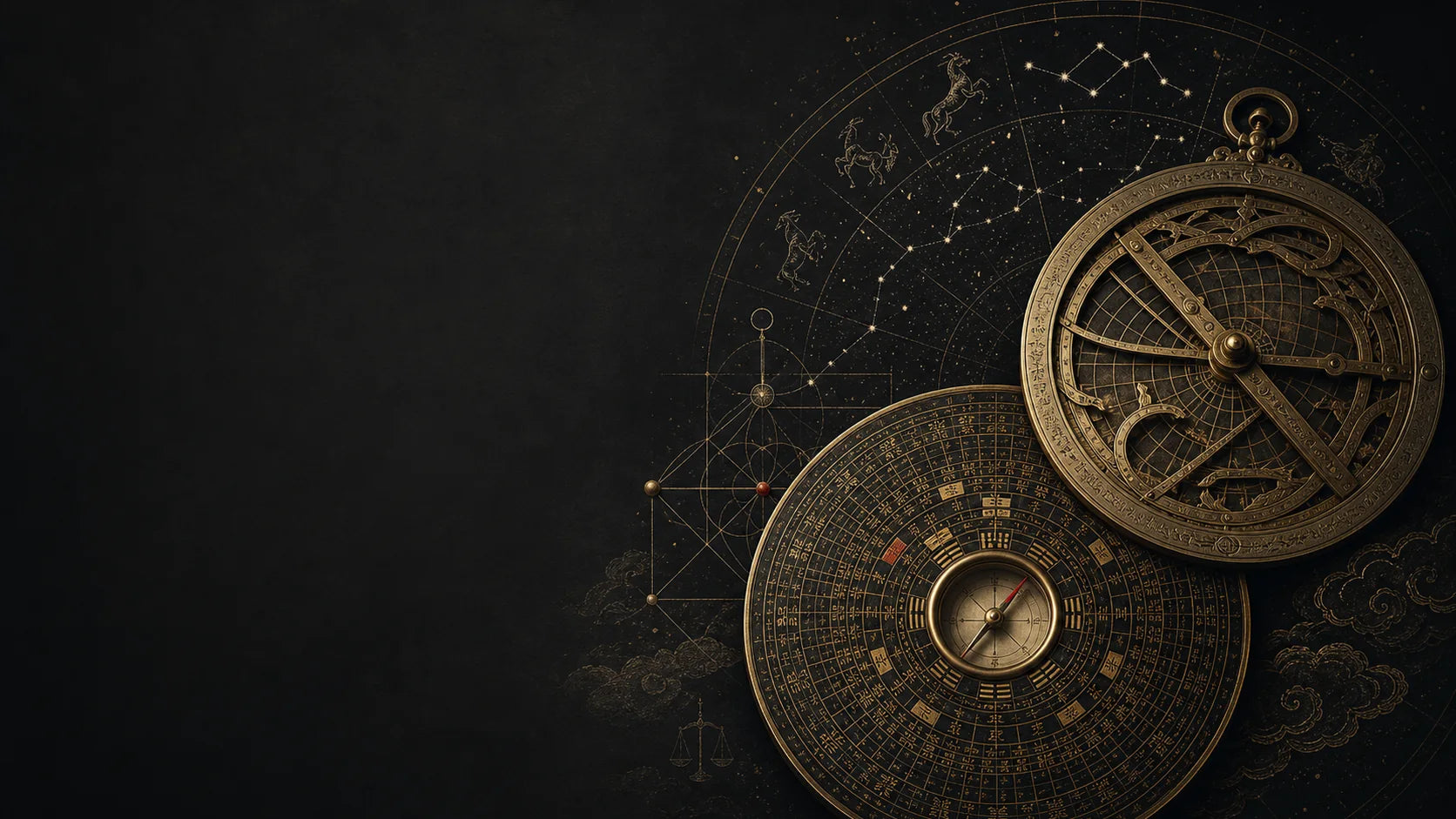
Two birth charts. Different symbolic languages.
Compare the Four Pillars with a Western natal chart without flattening either tradition into a zodiac-sign personality test.
- Inputs compared
- Symbols compared
- No forced conversion
What is the difference between BaZi and Western astrology?
BaZi uses four birth-time pillars, Heavenly Stems, Earthly Branches, Five Elements, and a Day Master. Western astrology uses planets, zodiac signs, houses, and aspects. Both create symbolic birth charts, but their calendars, visual structures, timing methods, and technical vocabulary are different.
BaZi and Western astrology organize the same birth moment differently.
Both traditions use birth information to build a symbolic chart, but their calendars, symbols, reference points, and interpretive languages are distinct.
| Feature | BaZi / Four Pillars | Western astrology |
|---|---|---|
| Core inputs | Birth year, month, day, local time, and birthplace | Birth date, exact time, and birthplace |
| Primary framework | Chinese calendar, solar terms, stems, branches, and Five Elements | Planets, zodiac signs, houses, aspects, and astronomical positions |
| Main reference point | Day Master: the Heavenly Stem of the Day pillar | Often Sun, Moon, and Ascendant, then the complete natal chart |
| Familiar zodiac label | Year Branch animal such as Dragon or Pig | Sun sign such as Aries or Scorpio |
| Timing language | Horoscope Cycles, years, months, and other calendrical layers | Transits, progressions, returns, and other timing techniques |
| Typical visual | Four vertical columns with eight characters | Circular natal chart wheel |
Twelve animals and twelve signs are not equivalent systems.
The Chinese zodiac's twelve animals correspond to Earthly Branches and repeat through years, months, days, and two-hour periods. The familiar public sign usually refers to the Year Branch.
The Western zodiac divides the ecliptic into twelve signs. A person's popular “star sign” usually refers to the Sun sign, while a full natal chart also includes the Moon, Ascendant, planets, houses, and aspects. Translating Dragon directly into Leo or Rat into Gemini has no standard basis.
Different maps can lead to different questions.
Neither system needs to be declared universally “better” for the comparison to be useful.
Use the system that answers the question you actually have.
You can study one, both, or neither. Clarity matters more than collecting labels.
- 01
Name the question
Are you exploring self-understanding, timing, relationship patterns, or simple cultural curiosity?
- 02
Check the birth data
Know whether the exact time and birthplace are available before expecting a complete chart.
- 03
Inspect the method
Choose a source that shows calculations, definitions, uncertainty, and ethical boundaries.
- 04
Avoid certainty claims
Do not pay more because someone promises guaranteed accuracy, fate, or a cure for bad luck.
Generate the Four Pillars version of your birth chart.
Enter the same birth details you would use for a natal chart and see how BaZi organizes them into eight characters.